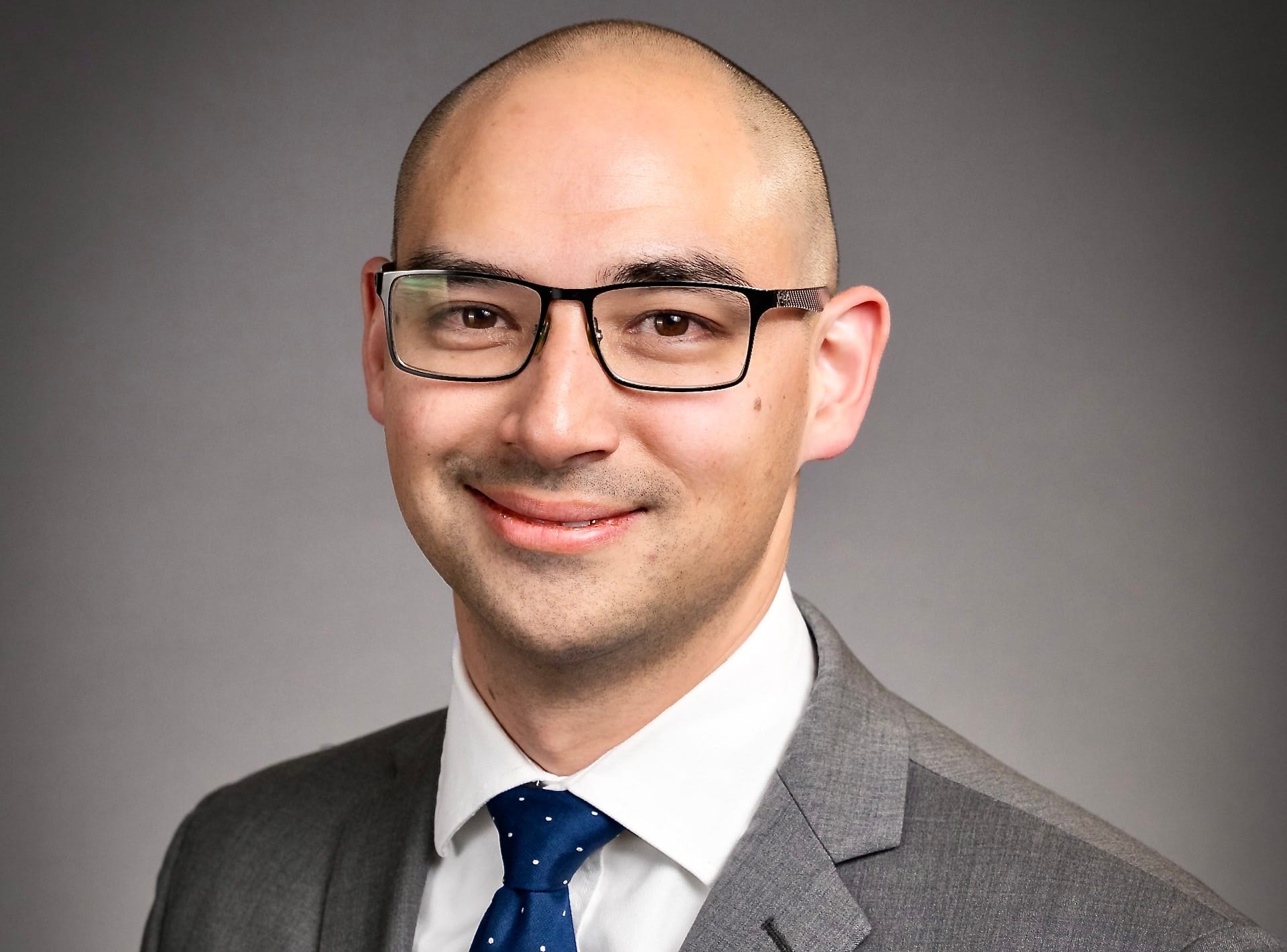
Attorney Alan Burow has joined the McCleskey Law Firm as a litigator, after spending eight years as a prosecutor with the Lubbock County District Attorney’s Office.
Burow originally came to Lubbock for college, but before that he spent time living in Ukraine and speaks multiple languages.
Burow graduated from Texas Tech Law School in 2018, after finishing his undergraduate degree at Lubbock Christian University.
“I was representing the state (of Texas) and dealing with important cases. But once that was done, I never saw the people again. I want to build ongoing relationships with clients if it’s one, or multiple cases and I can do that through civil litigation,” Burow said.
His law school friend, Garrett Oates, who joined the McCleskey Law Firm last year, suggested Burow might find a career home with the law partners he values and respects.
“Not too long ago, (Oates) reached out to me and said there was a need here in civil litigation … and asked me to meet the partners,” Burow said.
Burow and his wife, Toni, an award-winning teacher at Laura Bush Middle School, were impressed when they looked over the firm’s website and social media, he said.
“We did go looking through the Facebook page while I was considering making the jump and that was honestly one of the selling points for us to just see … the people in this office as people, not just as attorneys or production metrics.”
McCleskey partner Bill Lane said Burow’s experience in the court room makes him a great addition to the firm.
“We’re excited to have Alan Burow joining our law firm as an associate attorney. Mr. Burow comes with eight years-plus experience in trying cases and strongly believe he will be a great benefit in our litigation practice in the future,” Lane said.
It took some thinking for Burow to decide to leave a post in the Juvenile Division, where since 2021 he prosecuted juveniles who committed crimes. Before that he worked on varied cases and handled cases with adult defendants. “Most of the caseload involved DWI and assault offenses,” he said.
One of the reasons he studied law was to stand up for children who had been “victims of either inappropriate parental figures or life circumstances. It sparked a desire in me to be part of a process that hopefully makes a difference in their lives.”
Through his church in Arlington, he volunteered in high school and in college at a camp for underprivileged and at-risk youth in the San Francisco Bay Area, so he knew not everyone starts out on a level playing field.
He was also inspired in law school, when a professor, a former prosecutor who had a career as an U.S. Army JAG officer, taught a criminal justice class exploring crimes against children.
When Burow first started at LCU in 2009, he thought he’d study medicine, but vision problems stopped him from excelling as he wanted in lab work.
“But I consider that a blessing, because I am grateful for the career I’ve been able to establish in the law and to serve the people of Lubbock County,” he said.
Burow connected with his wife at church in 2021, just before he moved to the juvenile division at the District Attorney’s Office. It was during the social distancing days of COVID.
“She was wearing a mask and was one of the volunteers,” he said.
Toni was guiding people on procedures to enter and exit the building. He had known about her for a couple years because she was in a friend group of his best friend’s wife.
“My best friend’s wife tried to set us up two years prior and she said, no,” he remembered and joked. “She was not interested. All it took was a couple years, an epidemic and then suddenly I was an attractive proposition.”
Lubbock has been Burow’s home since his college days, but he started life in Killeen, where his father was a minister and an officer in the Texas National Guard. Korean was his first language, his mother’s native tongue. His father had met his mother in Korea, while he was in military service.
Burow remembers going to a special elementary school where they had resources for students with English as a second language.
His father was stationed at Fort Hood, near Killeen, until he and his family moved to Mariupol, Ukraine, to do mission work with their church when Burow was 10 years old.
“We lived there for about six years, so I am conversational in Russian because Eastern Ukraine primarily spoke Russian at that time.”
Burow also took Spanish in high school when his family moved back to the United States in Arlington.
“I don’t speak Korean anymore, but I think I could pick it up again. I took Spanish, of course, and I’ve tried to retain my Russian. So I’m juggling too many linguistic balls currently.”
While he was in high school and through college, Burow knew hard work. He remembers digging ditches for sprinklers on his 18th birthday. He installed digital network physical infrastructure through college.
“Running wires through ceilings and through trenches, makes you realize you don’t want to do that for a living. My body could not handle that as a career. But it opened my eyes to the value of hard work. The opportunities that I have are not the opportunities everyone else has had. I do not take that for granted,” he said.
Hard physical work made him understand and empathize with people who have lost not just bodily autonomy, but perhaps their livelihood or dignity. He’ll be honored to represent those people as clients, he said.
“I take the value of labor seriously and I treat the way I practice my job in the same light, recognizing that I’m entrusted to represent others who are not able to stand up for themselves or speak for themselves.
“As a student who had to go to a different school because he was not able to speak, I take the ability to speak for myself and others very seriously,” he said.